
Table of Contents
Table of Contents
Introduction
A midterm election gives American voters the power to reshape Congress halfway through a president’s four-year term. The presidency is not on the ballot, but every seat in the House of Representatives, roughly one-third of the Senate, and many state and local offices are contested. Those choices can change which party writes legislation, controls congressional committees, confirms federal nominees, and investigates the executive branch. For voters, understanding the ballot matters because a midterm is not merely a national opinion poll. It is a collection of separate races decided under different state rules and local political conditions.
The next United States midterm election is scheduled for November 3, 2026. Campaign coverage often concentrates on party control of Congress, yet an individual ballot may also include a governor, state legislators, judges, county officials, school-board members, and policy measures. A voter therefore makes several decisions with distinct consequences rather than casting one general vote for or against the president. This guide explains the structure, political importance, historical patterns, and practical evaluation of a midterm election while separating verified electoral rules from campaign predictions that can change before voting begins.

What Is a Midterm Election?
A midterm election is the federal general election held near the midpoint of a presidential term. Congressional elections occur every two years, including both presidential-election years and the even-numbered years between them. According to the official USAGov explanation of midterm elections, all 435 voting seats in the House and approximately one-third of the Senate are contested during a midterm. The label describes timing, not a separate constitutional category of ballot. Candidates still compete for specific offices, states administer voting, and the results determine who serves in the next two-year Congress.
Why Midterms Occur Every Two Years
The cycle comes from the different terms assigned to federal offices. Members of the House serve two-year terms, so they must face voters at every regular federal election. Senators serve six-year terms arranged in three classes, with one class generally reaching the ballot every two years. The president serves a four-year term, which creates one congressional election around its midpoint. This staggered design makes the House highly responsive to recent public opinion while preserving greater continuity in the Senate, where about two-thirds of members normally remain in office after each election cycle.
What a Midterm Election Does Not Decide
A regular midterm election does not elect the president or vice president, and the Electoral College is not used. Voters choose congressional, state, and local candidates directly according to the rules governing each contest. The president remains in office after the midterm, but may confront a different balance of power when the new Congress begins. Special circumstances can place additional races on a ballot, including elections to complete an unfinished Senate or House term. That is why voters should examine their official sample ballot instead of assuming every state presents the same list of offices.
What Voters Choose During a Midterm Election
Every House Seat
The House of Representatives is renewed in full. Each voter chooses a representative for a congressional district, and the party winning the most seats normally selects the Speaker and organizes the chamber. The official House overview confirms that representatives serve two-year terms and that the chamber has 435 voting members. A small movement across competitive districts can therefore transfer control. House outcomes influence tax and spending bills, committee investigations, impeachment proceedings, and which legislative proposals receive hearings or floor votes.
About One-Third of the Senate
Senate elections work differently because only one of the chamber’s three classes is regularly contested in a cycle. The Senate’s explanation of its class system notes that senators serve six-year terms and approximately one-third face election every two years. Voters elect senators statewide rather than by congressional district. Control can depend on a handful of close contests, but the map changes from cycle to cycle because each party may be defending a different set of seats. Special elections can also increase the number of Senate races held in a particular year.
Governors, Legislatures, and Local Offices
The federal contests are only part of the midterm ballot. Many states elect governors, attorneys general, secretaries of state, legislators, judges, and other officials during even-numbered years. Counties and municipalities may hold races or referendums at the same time, while statewide ballot measures can address taxes, electoral rules, public spending, constitutional amendments, or social policy. Election schedules are not uniform, so the directory of state and local election offices is more reliable than a national campaign calendar for local details. These lower-profile choices often affect public services more directly than a congressional race.
Midterm Election Versus Presidential Election
| Practical difference | Midterm election | Presidential election |
|---|---|---|
| Timing | Halfway through a four-year presidential term | At the end of a presidential term |
| President on the ballot | No | Yes |
| House seats | All 435 voting seats | All 435 voting seats |
| Senate seats | Approximately one-third, plus possible special elections | Approximately one-third, plus possible special elections |
| Electoral College | Not involved | Determines the presidential winner |
| State and local contests | Common, depending on state schedules | Common, depending on state schedules |
| Typical voter attention | Focused on Congress, state races, and the administration’s record | Dominated by the presidential contest |
| Immediate institutional effect | Can change congressional and state control | Chooses the president and can also change congressional and state control |
The comparison shows why calling a midterm a smaller presidential election is misleading. Both election types renew the entire House and part of the Senate, but only one chooses a president. Midterm voters encounter greater variation in candidate visibility because congressional and state races lead the ballot. That creates a practical responsibility: evaluate each office separately. A voter can support candidates from different parties, skip a contest, or take different positions on ballot measures. The final outcome is built race by race, not calculated from one nationwide popular vote.
Why Midterm Elections Matter
Control of Congress
Congressional majorities determine chamber leadership, committee chairs, hearing schedules, and the legislation that reaches a vote. If the president’s party loses one chamber, major bills may require negotiation with the opposition or stall entirely. A change in the Senate can also alter the path for judicial and executive nominations, while a House change can redirect oversight priorities. The House historian reports that the chamber has changed majorities in a midterm a little more than one-third of the time, demonstrating that turnover is consequential without being automatic.

Oversight and the President’s Agenda
Midterms are frequently interpreted as a judgment on the sitting administration because they occur after nearly two years of presidential decisions. That interpretation has limits: voters choose local candidates, and individual races respond to different conditions. Institutionally, however, the result can strengthen or constrain the White House. A supportive Congress may advance budgets and policy proposals more easily. An opposing chamber can block legislation, issue subpoenas, conduct investigations, and use hearings to challenge executive actions. Divided government does not eliminate lawmaking, but it changes bargaining power and usually narrows what can pass without cross-party support.
State Policy and Ballot Measures
State results can change laws governing education, health programs, taxation, energy, policing, labor, housing, and election administration. Governors may sign or veto legislation, while state lawmakers control budgets and write statutes within constitutional limits. Attorneys general and secretaries of state exercise different powers depending on state law. Ballot measures sometimes let voters approve policies directly, but the wording can be technical and the fiscal effects may extend beyond the campaign slogan. Reading the official explanatory statement and arguments before voting provides a better basis for judgment than relying on an advertisement’s simplified description.
What Shapes Midterm Election Results
The Economy and National Mood
Economic conditions often influence how voters evaluate the party holding national power. Prices, wages, employment, housing costs, and consumer confidence can shape political attention even when federal officials do not control every cause. In July 2026, Pew Research Center reported that economic issues, especially prices and affordability, were the topics registered voters most wanted congressional candidates to address. That finding describes opinion at the survey date; events, campaigns, and local circumstances can change priorities before Election Day.
Turnout and Voter Motivation
Midterm outcomes depend not only on what the public believes but also on who participates. The Census Bureau estimated that 52.2% of the citizen voting-age population voted in 2022, compared with 53.4% in the 2018 midterm. Its 2022 voting and registration report also found a 69.1% registration rate. National percentages conceal substantial differences among states and demographic groups. Close races may turn on whether campaigns persuade occasional voters to register, request ballots correctly, and complete voting before the applicable deadline.
District Boundaries and Incumbency
House competition occurs inside district lines drawn after the census through processes that vary by state. Population distribution, redistricting choices, and geographic concentrations of voters can produce safe or competitive seats before campaigning begins. Incumbents often benefit from name recognition, donor networks, staff experience, and a record of constituent service, although those advantages cannot guarantee reelection. Senate and gubernatorial races use statewide electorates, so their political geography differs from House contests. Serious analysis examines the specific electorate and previous margins rather than applying a national polling number mechanically to every race.
Candidate Quality and Local Issues
National conditions create pressure, but candidates still matter. Experience, fundraising, message discipline, personal controversies, debate performance, and connection to the district can change a contest’s direction. A campaign centered on immigration or inflation nationally may compete with a local concern such as water access, factory closure, disaster recovery, transportation, or school funding. Third-party and independent candidates can also affect margins even when they are unlikely to win. Evaluating a midterm election therefore requires two levels of analysis: the broad environment influencing many races and the distinctive facts shaping each ballot choice.
How Primaries Lead to the General Election
Before the November general election, parties usually use primaries, caucuses, conventions, or another state-authorized process to select nominees. Rules differ on voter eligibility, party registration, runoff requirements, mail voting, and candidate access. The 2026 state primary calendar demonstrates how widely dates vary across the country. A primary can strongly influence the final contest by determining whether a party nominates a broadly acceptable candidate, an ideological favorite, or someone especially suited to the district. Missing a primary means surrendering influence over which choices appear later.
The general election then places qualified nominees and any eligible independent or third-party candidates before voters. Most congressional races award the office to the candidate receiving the most votes, but state procedures can create exceptions, including ranked-choice systems or runoff requirements. Deadlines for registration, absentee requests, ballot return, and identification also depend on jurisdiction. The Federal Election Commission lists federal election dates, while state election authorities provide the controlling instructions for voters. Campaign mail or social-media posts should never replace those official rules.
How to Research a Midterm Ballot
Begin with the official sample ballot for the address where you are registered. List every office and measure, then compare candidate websites, financial disclosures, voting records, debate footage, reputable local reporting, and nonpartisan voter guides. Distinguish a candidate’s stated proposal from a law already enacted, and check whether the office actually possesses the power being promised. USAGov’s guide on researching candidates and sample ballots provides a neutral starting point. Complete this work before voting begins, because judicial races, local propositions, and retention questions can require more investigation than prominent congressional contests. These are the races where late, improvised choices are least informative.
How to Register and Prepare to Vote
Registration rules are controlled by states, so there is no single national deadline for a midterm election. Vote.gov’s registration portal notes that some states close registration weeks before Election Day, while others permit registration on Election Day. Check your status even if you voted previously, especially after moving, changing your name, becoming a citizen, or remaining inactive for several election cycles. Use the official state link supplied by Vote.gov, record the submission date, and save any confirmation number instead of registering through an unsolicited message or advertisement.
Preparation extends beyond registration. Confirm the residential address attached to your record, locate the correct polling place, review identification requirements, and learn whether your state offers ballot tracking. Download the official sample ballot when it becomes available and note contests that appear on later pages or the reverse side. If assistance or an accessible voting system is required, contact the local election office before voting begins. Early preparation leaves time to correct administrative errors; discovering an outdated address or missing mail-ballot request on Election Day creates fewer options.
Early, Absentee, Mail, and Election Day Voting
Most states provide an early in-person option, although dates, locations, weekend hours, and eligibility requirements vary. The official early-voting guide directs voters to the rules for their jurisdiction. Early voting can reduce scheduling risk and provide additional time to resolve a registration or identification issue. It is not an informal preliminary vote: a valid early ballot counts in the same election. Before traveling, verify the location and hours because early-voting sites may differ from the polling place assigned for Election Day.
Absentee and vote-by-mail systems also differ among states. Some jurisdictions automatically mail ballots to registered voters, while others require a request and may ask for an accepted reason. Follow the official absentee and mail-voting instructions, including signature, witness, identification-copy, envelope, and return-deadline requirements. Complete the ballot in private, use the correct envelope, and return it early enough to satisfy the governing receipt or postmark rule. Where tracking is available, confirm that election officials received and accepted it rather than assuming that mailing completed the process.
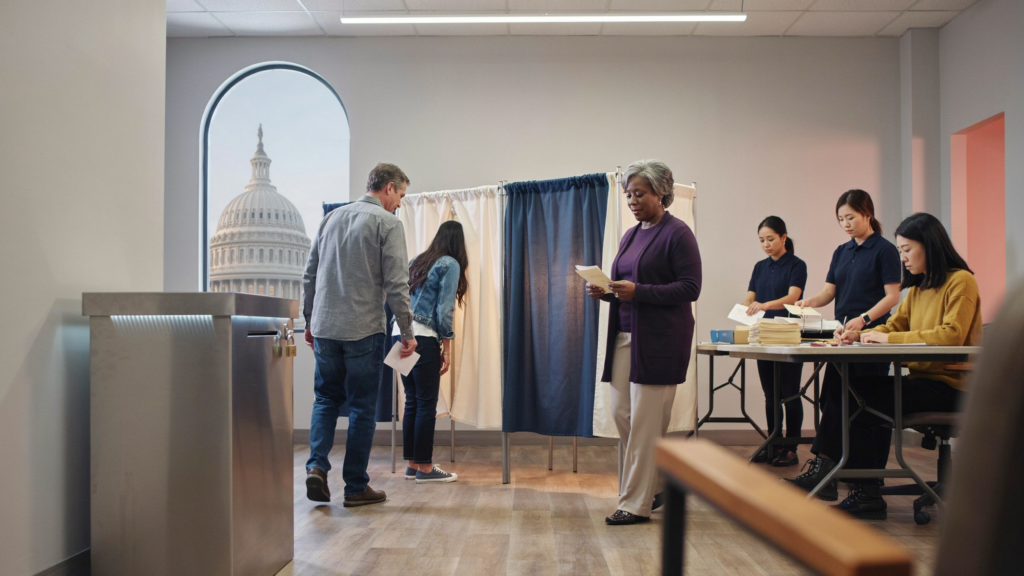
Election Day voters should recheck their polling place shortly before leaving because emergency changes can occur. Bring any identification required by state law and allow enough time for lines, transportation, and ballot review. A voter in line by the jurisdiction’s closing time generally should remain and follow instructions from election workers. Federal elections do not permit ordinary internet voting; USAGov confirms that federal ballots are cast in person or through an authorized absentee or mail process. Treat links claiming to collect an online federal vote as fraudulent.
How Campaign Money and Political Advertising Work
Federal candidates and committees report receipts and spending to the Federal Election Commission, allowing voters to examine who funds a campaign and how money is used. The FEC’s 2025–2026 contribution limits allow an individual to give a federal candidate up to $3,500 per election, meaning the primary and general election have separate limits. A large campaign total does not prove broad public support because funds may come from different donor types, transfers, or previous periods. Examine donor concentration, spending pace, debts, outside expenditures, and reporting dates together.
Political advertising also requires attention to the sponsor. A message paid for by a candidate campaign differs legally and strategically from one funded by a party, political action committee, nonprofit organization, or independent-expenditure group. Federal rules generally require covered communications to identify who paid for them, as the FEC’s advertising and disclaimer guidance explains. Read the disclaimer before evaluating the claim, then seek the original speech, vote, court decision, or economic data being cited. Editing and selective context can make a technically authentic clip misleading.
How to Read Polls and Election Forecasts
A poll estimates opinion among a defined population at a specific time; it does not count future votes. Check who sponsored it, when interviews occurred, sample size, population surveyed, contact method, question wording, weighting, and margin of error. The American Association for Public Opinion Research explains that the margin of error represents a range around an estimate, not certainty about the final outcome. A two-point lead in a poll with greater statistical uncertainty should be described as close, especially when undecided voters and turnout assumptions remain important.
Forecasts add models, historical data, fundraising, district characteristics, and multiple polls to estimate probabilities. A candidate assigned a 70% chance is favored, not guaranteed; an event with a 30% probability occurs regularly. Avoid converting probability into predicted vote share or treating a ratings change as proof that voters suddenly moved. Compare several transparent models, read their methodology, and look for uncertainty intervals. Statewide polling should not be used to infer individual House districts, and national generic-ballot surveys cannot identify which specific seats will determine control.
Election Night, Vote Counting, and Certification
Election-night totals are unofficial reports, not the certified final result. Jurisdictions count different ballot categories on different schedules, and state law may allow valid mail, provisional, military, or overseas ballots to be processed after polls close. As later batches come from areas with different voting patterns, a candidate’s percentage can move without any ballot being altered. The Election Assistance Commission’s canvassing guide explains that officials aggregate and confirm valid ballots from early voting, Election Day, mail, provisional, and overseas sources before certification.
Responsible interpretation begins with the jurisdiction’s official results page and its timestamp. Media organizations may project a winner when their statistical analysis indicates that remaining votes cannot change the outcome, but a projection is not certification. Close contests may involve recounts, audits, cured ballot defects, or litigation governed by state deadlines. A delayed call does not itself indicate misconduct; it often reflects the number and type of uncounted ballots. Compare current totals with the estimated outstanding vote and wait for election officials to explain discrepancies before sharing claims.
What to Know About the 2026 Midterm Election
The 2026 general election is scheduled for November 3, but registration, early-voting, and mail-ballot dates remain state-specific. Beyond federal races, the National Conference of State Legislatures reports that voters in 46 states will choose 6,139 state legislators, covering more than 83% of state legislative seats nationwide. Territories and the District of Columbia also hold legislative contests, and numerous ballots contain policy measures. This scale makes national headlines incomplete: state control and local propositions may produce major policy changes without affecting congressional totals.
Campaign conditions can still change before voting concludes. Economic perceptions, international events, court decisions, candidate withdrawals, redistricting disputes, primary outcomes, and late advertising may alter individual races. Follow official election calendars for procedural facts and treat polling as dated evidence rather than a permanent ranking. Evaluate the 2026 midterm election at three levels: national control of Congress, statewide contests such as Senate or governor, and the district-level choices on the actual ballot. That framework prevents one dramatic headline from replacing a complete assessment of the election.
Conclusion
A midterm election redistributes governing power without selecting a president. Its practical importance lies in congressional control, state leadership, local administration, and policy measures that can shape law for years. An informed voter verifies registration, studies every ballot contest, distinguishes campaign claims from source evidence, and chooses a voting method early enough to meet state rules. Polls and election-night projections provide information, but neither replaces completed ballots and certified results. For the 2026 midterm election, the sound approach is procedural accuracy first, candidate and policy evaluation second, and prediction only where evidence supports it.
Frequently Asked Questions
When is the 2026 midterm election?
The federal general election is scheduled for Tuesday, November 3, 2026. Registration deadlines, early-voting periods, absentee-request dates, and mail-ballot return rules differ by state. Some jurisdictions may also hold runoffs or special elections on other dates. Verify the calendar through your state or local election office, not through campaign material, because the official authority controls deadlines and any emergency changes.
Can I vote in a midterm election if I skipped the primary?
Yes. Eligible voters may generally participate in the general election even if they did not vote in a party primary. Primary participation determines party nominees; it is not normally a prerequisite for November voting. You must still satisfy registration and identification rules applicable in your state. In the general election, voters are not required to support the party with which they registered.
How can I find everything appearing on my midterm ballot?
Use the sample-ballot tool provided by your state or local election authority and confirm that it matches your registered address. Congressional districts, state-legislative districts, municipalities, and school districts can divide nearby households into different ballots. Review every page for judges, retention questions, local offices, and propositions. Candidate websites or national voter guides may omit contests, so use the official sample as the master list.
Can I cast my midterm election vote online?
No ordinary online voting system is available for federal elections in the United States. Voters use authorized in-person, absentee, or mail-ballot procedures established by their jurisdiction. Some military and overseas voters may receive materials electronically under special rules, but that does not create general internet voting. Never submit personal data or supposed ballot choices to a website claiming it can record a federal vote online.
Why can midterm election results change after Election Day?
Results move as officials add legally valid ballot categories that were not included in the first report. These can include mail, provisional, cured, military, overseas, and late-reporting precinct ballots. The order of counting may favor different candidates at different times. Officials then reconcile totals, conduct required audits or recounts, and certify the result. A changing percentage is a normal mathematical consequence of adding votes.
What should I do if I moved before the election?
Check and update your voter registration immediately because a new address may place you in different congressional, legislative, and local districts. Follow your state’s instructions on registration deadlines and whether you must vote at the old or new location during the transition. Do not assume postal forwarding updates election records. Contact the local election office directly if the online status tool displays outdated or conflicting information.
How should I judge a close midterm election poll?
Treat it as a range rather than an exact score. Review the field dates, target population, sample size, method, sponsor, question order, undecided share, and margin of error. Compare several independent polls instead of selecting the most favorable result. When the candidates’ ranges overlap, the poll does not establish a clear leader. Even a genuine lead can change because opinion and turnout develop after interviewing ends.