
The landscape of European football recruitment is defined by high-stakes negotiation, regulatory scrutiny, and a relentless pursuit of generational attacking talent. At the absolute center of this competitive storm is the escalating narrative surrounding a potential Julián Álvarez transfer Barcelona transaction, a strategic move that has completely captivated fanbases across Catalonia and the broader sporting world. Following the high-profile departure of veteran striker Robert Lewandowski, Barcelona’s sporting department has prioritized the acquisition of an elite forward capable of spearheading a high-intensity tactical rebuild. Striking a deal with a direct LaLiga competitor like Atlético Madrid requires an extraordinary combination of economic engineering, player leverage, and institutional patience.
Institutional transfers between direct title rivals are inherently complicated by political pride, competitive anxieties, and public relations positioning. While Barcelona has actively engaged intermediaries to structure a highly competitive multi-year financial proposal, Madrid’s board has maintained an incredibly firm and defensive public stance. This developing Julián Álvarez transfer Barcelona saga has quickly transformed from a routine corporate evaluation into a complex psychological chess match where every media leak and social media campaign serves a distinct strategic purpose. As the official registration deadlines draw closer, the ultimate resolution of this high-profile standoff will undoubtedly dictate the competitive balance of power at the absolute pinnacle of Spanish club football according to updates from Fabrizio Romano on X.
Table of Contents
Analyzing the Tactical Reconfiguration Under Hansi Flick
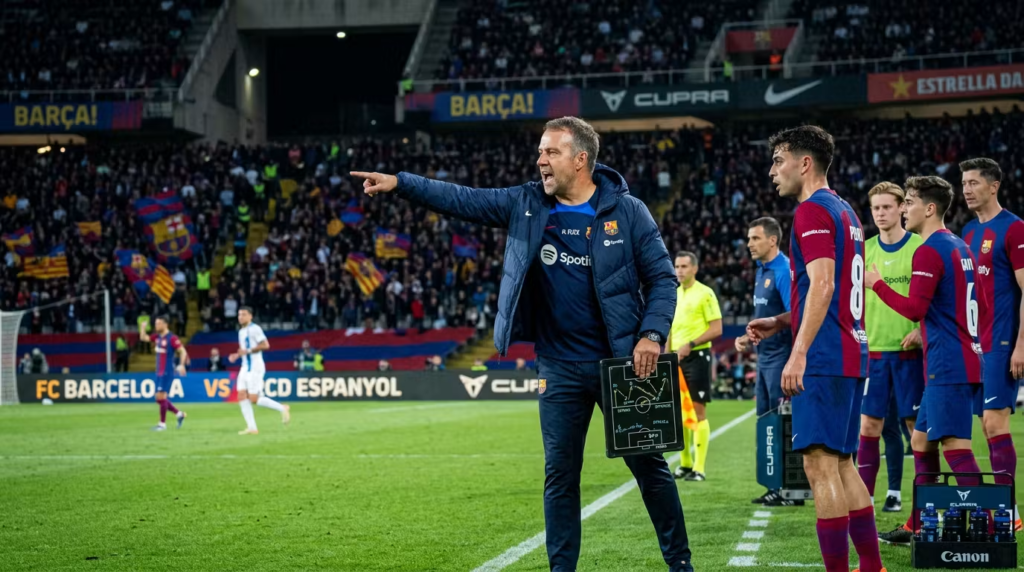
Understanding Barcelona’s aggressive pursuit of the dynamic Argentine international requires a deep dive into the specific tactical evolution introduced by manager Hansi Flick. The German tactician demands a relentless out-of-possession defensive structure paired with lightning-fast vertical transitions that immediately exploit spaces vacated by retreating opposition backlines. The vacancy left by traditional number nines requires the integration of a highly modern attacker who values defensive industry just as much as pure offensive output. Flick views the integration of the industrious forward as the ideal catalyst to unlock the true potential of his young squad, establishing a highly aggressive pressing triggers across the final third of the pitch.
Unlike rigid target men who remain relatively static within the boundaries of the eighteen-yard box, the current Atlético forward constantly drifts across horizontal channels to disrupt defensive coordination. His elite spatial awareness allows him to drop effectively into central midfield pockets, drawing opposing center-backs out of position and creating massive corridors for elite inverted wingers like Lamine Yamal to exploit. This specific style of modern positional play makes the attacking unit incredibly fluid and difficult for defensive blocks to prepare against. By combining elite clinical finishing with a tireless defensive work ethic, this potential Julián Álvarez transfer Barcelona execution represents the exact tactical profile required to execute complex modern footballing ideas.
Boardroom Friction and the Verbal Compacts of the Metropolitano
While the sporting compatibility between the player and the Catalan club appears flawless, the operational execution of the transfer faces immense resistance within the capital’s executive offices. Atlético Madrid’s directors have adopted an incredibly stubborn posture, signaling through public communication channels that they have no intention of authorizing a departure for less than a record-breaking financial premium. This institutional stance is partially designed to protect their corporate brand equity and placate an emotional fanbase that is deeply hostile to the idea of selling premium assets to domestic rivals. The public friction has been further intensified by heated digital banter and provocative social media campaigns across major online networking spaces.
Despite the firm public resistance maintained by Los Colchoneros, investigative journalists across Spain have revealed critical underlying friction regarding historical verbal promises. Reports circulating on high-profile sporting programs suggest that Atlético’s chief executive officer had previously extended a clear gentlemen’s agreement to the player’s camp during a difficult winter registration period. This informal understanding reportedly guaranteed that the institution would actively facilitate an exit if an elite European side delivered an authoritative valuation packet that met specific capital criteria. The player’s representatives are actively leveraging these past boardroom agreements to apply psychological pressure on the capital club, urging them to honor their commitments and greenlight the Julián Álvarez transfer Barcelona deal.
Economic Feasibility and Navigating Financial Regulations
Executing an operational acquisition of this magnitude demands extraordinary financial discipline from Barcelona’s executive committee to ensure absolute compliance with LaLiga’s economic sustainability frameworks. The club has worked tirelessly to stabilize its overall debt matrix and refine structural wage allocations, meaning they can approach high-profile negotiations with significantly greater security than in previous fiscal cycles. Returning to more balanced spending regulations grants the Catalan board the necessary institutional power to propose creative, performance-tiered compensation frameworks that protect immediate liquid reserves. Spreading the amortized cost of the transfer over a long-term contract allows the club to maintain regulatory balance.
| Performance Dimension | Julián Álvarez Attacking Profile | Traditional Target Forward |
| Pressing Intensity Matrix | Relentless Counter-Pressing Engagement | Intermittent Position Retention |
| Positional Fluidity Index | High Lateral and Vertical Mobility | Strictly Centered Box Presence |
| Combinational Play Style | Rapid One-Touch Spatial Access | Static Hold-Up Distribution |
| Career Longevity Horizon | Mid-Twenty Peak Longevity Window | Advanced Career Phase Management |
| Defensive Phase Tracking | Active Tracking Into Middle Third | Minimal Phase Participation |
Furthermore, the persistent threat of outside intervention from wealthy, cash-rich English Premier League clubs forces Barcelona to manage their operational timeline with immense precision. Elite English sides possess the immediate capital reserves to satisfy Madrid’s steep evaluation without requiring complex structural delays or structural financial engineering as shown by his current market value statistics on Transfermarkt. This latent competitive threat means Barcelona must aggressively capitalize on the player’s clear and explicit personal desire to call the Spotify Camp Nou his home. Utilizing the player’s strong individual preference serves as the primary leverage point to break the current boardroom gridlock and force a mutually acceptable compromise on the final Julián Álvarez transfer Barcelona fee.
Tactical Formations and System Integration Under Hansi Flick

The successful execution of the Julián Álvarez transfer Barcelona operation would immediately initiate a comprehensive tactical overhaul within Catalonia’s coaching staff. Managing an elite sporting institution requires more than just gathering high-profile assets; it demands the creation of a balanced tactical ecosystem where each player’s individual attributes amplify the collective strength of the unit. Head coach Hansi Flick has built a stellar reputation on implementing high-intensity, vertical pressing systems that completely suffocated opponents during his historic tenures in Germany. To replicate that level of domestic and continental dominance at the Spotify Camp Nou, the tactical department must carefully map out how the modern forward adapts to a highly demanding positional framework.
Integrating a versatile attacking element into an already dynamic frontline presents an exciting challenge for Barcelona’s technical staff. The structural shift away from a traditional, static target forward allows the coaching staff to experiment with fluid offensive shapes that continuously morph throughout different phases of possession. By analyzing the pressing triggers, vertical running paths, and spatial distributions of the incoming forward, the club can construct a resilient tactical plan designed to unlock deep defensive low-blocks. This tactical evolution will define Barcelona’s competitive identity as they navigate an increasingly demanding domestic and European calendar.
Optimizing the Three-Man Frontline with Anthony Gordon and Lamine Yamal
The primary tactical objective for Hansi Flick is the optimization of a terrifyingly fluid three-man attacking frontline that blends raw pace, elite elite dribbling ability, and tireless defensive industry. Following the blockbuster acquisition of Anthony Gordon on the left wing and the astronomical rise of Lamine Yamal on the right, the central forward position must act as the cohesive engine that binds these distinct profiles together. Rather than acting as a simple focal point for traditional aerial crosses, the central forward in this revamped system must excel at creating space through continuous horizontal and vertical rotations. The tactical intelligence of the Argentine international makes him uniquely qualified to execute these demanding positional shifts without disrupting team balance.
When Barcelona controls possession in the final third, the central forward’s natural inclination to drop deep into the midfield half-spaces will create a massive tactical dilemma for opposing central defenders. If a defender follows him into deeper zones, a massive space opens up immediately behind the defensive line for a lightning-fast winger like Anthony Gordon to exploit via sharp diagonal underlapping runs.
Conversely, if the opposition defense chooses to drop off and protect the space behind them, the forward receives the ball with complete freedom to turn and combine directly with Lamine Yamal. This reciprocal spatial relationship ensures that Barcelona constantly retains a numbers advantage in central areas while maintaining lethal isolation patterns out wide, validating why the club is pushing so hard for the Julián Álvarez transfer Barcelona operation.
Pressing Architecture and Out of Possession Systems
Beyond the obvious offensive benefits, the potential incorporation of the tireless forward completely transforms Barcelona’s out-of-possession defensive architecture. Hansi Flick’s tactical philosophy is entirely dependent on the immediate execution of a intense counter-press the very second possession is conceded in advanced areas. A traditional forward often lacks the physical recovery capacity or defensive awareness required to spearhead this exhausting defensive phase across consecutive high-stakes matches. The former Manchester City attacker, however, has spent years developing elite pressing habits under some of the most tactically demanding managers in modern football history.
In Flick’s defensive blueprint, the central striker is tasked with directing the entire team’s pressing movement by aggressively cutting off passing lanes between the opposition’s central defenders and their defensive midfielders. By using a curved running approach, the forward forces the opponent to play the ball toward the touchlines, effectively trapping them in pre-determined zones where aggressive wingers and advanced central midfielders can swarm the ball carrier. This elite defensive work rate significantly reduces the physical burden placed on Barcelona’s aging midfield line, preventing dangerous counter-attacks before they can even cross the halfway line.
Frequently Asked Questions: Est-ce qu’Alvarez doit venir au Barça ?
Why does Hansi Flick prioritize a dynamic forward over a traditional target man
Hansi Flick prioritizes a dynamic forward because his modern tactical system relies heavily on continuous high-pressing triggers and rapid, unpredictable vertical transitions. Traditional target men often lack the necessary physical mobility to sustain this level of out-of-possession defensive work across ninety minutes of elite competition. A mobile attacker ensures the frontline remains fluid, cohesive, and capable of generating immediate turnovers deep inside the opposition’s half.
How does LaLiga economic sustainability framework impact this potential transaction
LaLiga’s economic sustainability framework forces clubs to strictly balance their total squad expenditures, including player amortization costs and gross salaries, against verified revenue streams. Barcelona must carefully calculate the fiscal impact of any incoming transfer to avoid triggering strict regulatory penalties or registration delays. Utilizing performance-conditioned payment tiers allows the institution to integrate elite talent while maintaining absolute compliance with domestic financial oversight committees.
Est-ce qu’Alvarez doit venir au Barça ?
Oui, l’arrivée de Julián Álvarez au FC Barcelone est une nécessité absolue pour franchir un palier technique sous l’ère Hansi Flick. Le profil de l’attaquant argentin correspond exactement aux exigences du football moderne: un pressing étouffant, une polyvalence tactique rare et un réalisme clinique devant le but. Après la fin de cycle de Robert Lewandowski, le Barça a cruellement besoin d’un leader offensif capable de libérer des espaces pour les jeunes prodiges comme Lamine Yamal tout en garantissant plus de vingt-cinq buts par saison. Malgré la complexité financière de l’opération et le refus initial de l’Atlético de Madrid, forcer ce transfert est le choix le plus cohérent pour sécuriser l’avenir de l’attaque barcelonaise sur le long terme.
What role do historical gentlemen agreements play in modern football negotiations
Informal gentlemen’s agreements carry immense psychological weight and player-management leverage during complex transfer standoffs, even though they lack strict legal enforceability. When an executive extends a verbal promise to a player’s camp, failing to honor that compact can severely damage dressing room morale and sour relationships with powerful agency representatives. Players frequently utilize these historical understandings to justify a formal transfer request, forcing institutions to negotiate in good faith to complete the Julián Álvarez transfer Barcelona transition.